Every business goes through this at some point. An SEO audit report lands in your inbox. It’s full of data, charts, and details but somehow, it doesn’t tell you what actually matters.
You read through pages, yet there’s no clarity, no direction, no action. That’s the core problem with most audit processes today, the information is there, but the communication isn’t.
So before we learn how to read an audit report, let’s clarify 5 C’s of audit findings
What Is an Audit Finding?
An audit finding is the core result or observation uncovered during an audit process.
It shows what’s happening, why it’s happening, and what needs to change.
In simple terms, it explains what’s happening between data and decision-making.
When structured well, an audit finding helps management see the full picture, not just what’s wrong, but how to fix it.
So, that’s exactly where the 5 elements of an audit finding, also known as the 5 C’s, come in.
Why Audit Findings Matter
Audits aren’t just about compliance, they’re about clarity.
Businesses usually rely on audits to identify inefficiencies, assess performance, and uncover opportunities.
Whether it’s a financial audit, a marketing performance review, or a technical SEO audit process, the purpose remains the same:
→ To help you understand what’s working, what’s not, and what to improve.
But here’s the truth, an SEO audit is only as good as how well its findings are communicated.
I know you want to learn how to read an audit report and I get you. 5 C’s framework will help you make sure every observation becomes clear, cradible and actionable
The 5 Elements of an Audit Findings (The 5 C’s)
1. Condition
The Condition describes what is actually happening.
This is your current state… factual, specific, and data-backed.
It’s where your observation begins.
Example:
“Website load time exceeds 5 seconds on main landing pages, affecting user experience and SEO rankings.”
2. Criteria
The Criteria defines what should be happening, your benchmark or expected standard.
This comparison adds context and helps identify the gap between performance and expectation.
Example:
“The standard website load time should be under 2.5 seconds to meet Google’s Core Web Vitals and improve conversions.”
Without clear criteria, your finding is just an observation, not an insight.
3. Cause
Here you explain why the issue exists.
This could be a technical error, process flaw, lack of training, or an outdated system.
The Cause helps you trace the problem back to its root.
Example:
“Unoptimized images and lack of caching are causing extended load times.”
4. Consequence
The Consequence details why this matters.
What impact does the issue have on the organization’s performance, compliance, or reputation?
Example:
“Slow load speeds reduce conversions, increase bounce rates, and hurt SEO performance, directly affecting revenue potential.”
This step turns a technical observation into a business reality.
5. Corrective Action
Finally, outline how to fix it.
The Corrective Action turns the audit finding into a roadmap for improvement.
Example:
“Optimize images, enable caching, and implement lazy loading to reduce load times and boost Core Web Vitals.”
It’s the most actionable part of the audit, where problems are transformed into measurable improvements.
5 C’s Together
When you apply these 5 elements of an audit finding, you turn your report from a data dump into a story, one that flows logically:
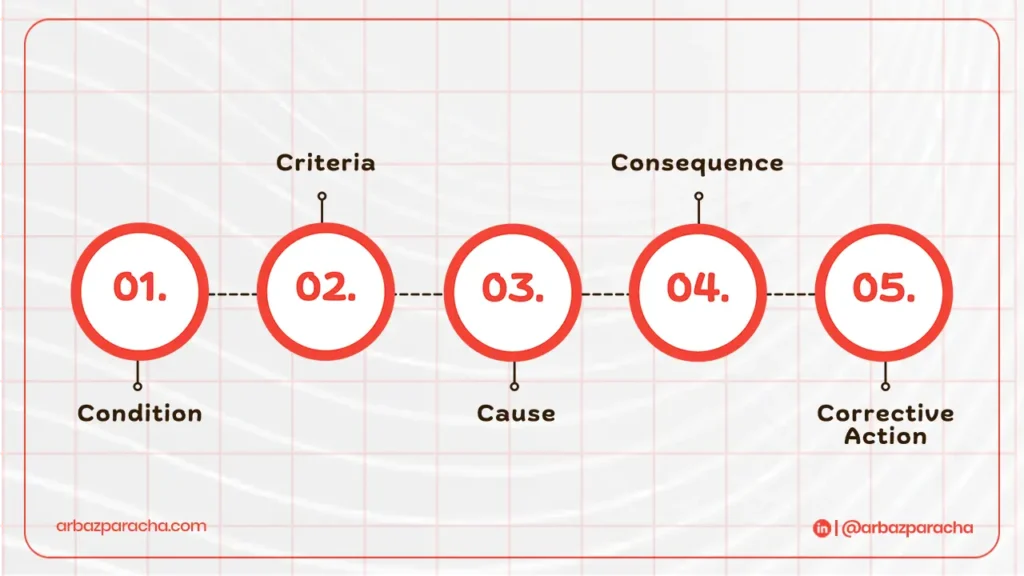
This structure gives every stakeholder clarity and direction.
It shows not just what’s wrong, but why it happened and how to fix it.
A great audit doesn’t just collect info it creates impact too.
By structuring your findings using the 5 C’s of audit findings, you ensure every insight leads to improvement.
Whether you’re auditing a financial process, a website system, or an SEO campaign, this framework turns your findings into action plans.
Because clarity drives confidence and confident decisions drive growth.
Want help with your next audit report? Let’s talk about it 😉