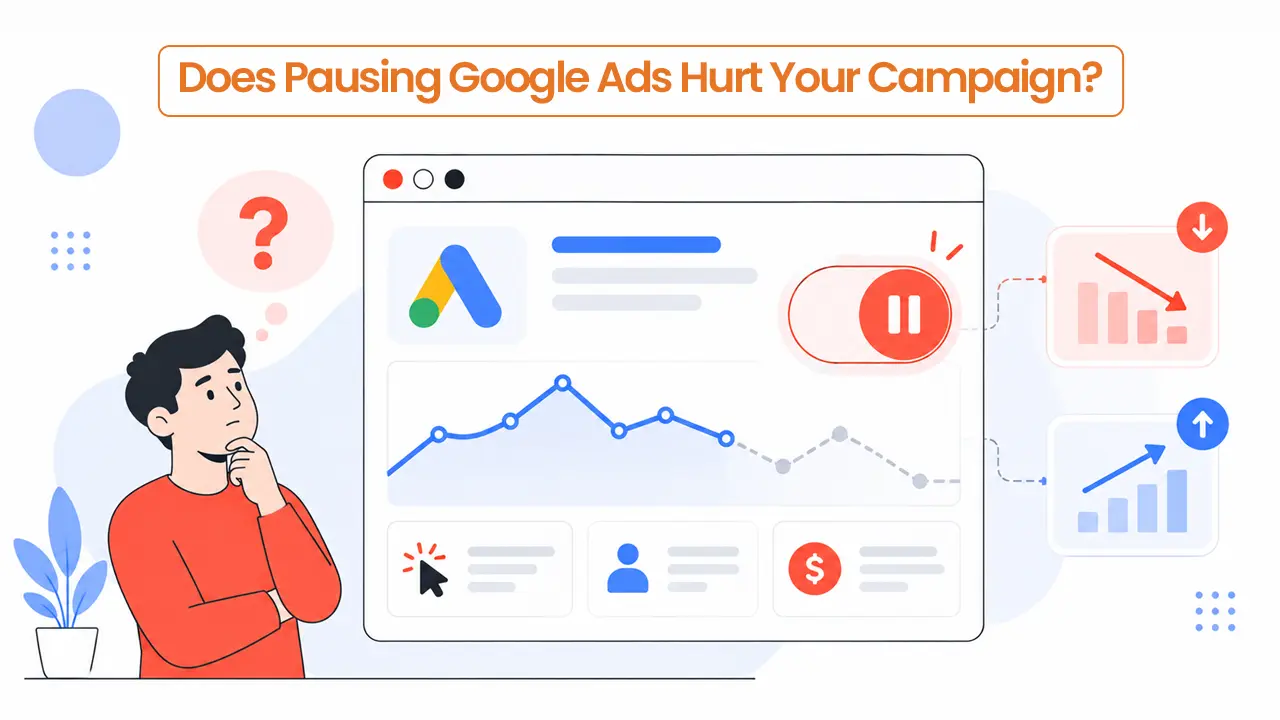
Imagine your business slowing down, and the budget will be the first thing you’ll cut. Pausing google ads feels free as no new charges, nothing deleted, just a button you pressed. The campaign is sitting there, waiting.
But is it safe for your campaign?
Let’s discuss this in depth and what to do instead.
Why People Pause Google ads in the First Place
It’s rarely about the ads under performing. It’s usually a slow month, a staffing gap, or a budget review that lands at the wrong time.
The logic feels sound, if no one’s buying right now, why pay for clicks?
So they pause it, resume it later, pick up where you left off.
But that last part is the assumption that causes the problem.
What Happens In Reality
Your campaign’s history doesn’t disappear. Past conversions, past spend, past performance data, all of it stays in the account. In that sense, pausing is not the same as deleting a campaign.
But Google Ads treats paused and resumed as a significant change to the campaign. When you turn it back on, Smart Bidding doesn’t simply continue from where it left off, it re enters a learning phase.
During that phase, the algorithm is re-testing how to bid for your conversions using whatever recent signal it can find. If your account runs on automated bidding (Target CPA, Target ROAS, Maximize Conversions), this relearning period is where the real cost shows up, not in the pause itself, but in the restart.
Quality Score doesn’t technically decay while a campaign sits paused. But Quality Score is partly based on recent click through rate. If your resumed ads under performs while the algorithm re calibrates, that recent CTR dip can drag the live Quality Score down, which raises what you pay per click, right as you’re trying to get going again.
Example
Picture a local Service HVAC company running Google Ads at a $70 cost per lead, stable for three months. Their business slows in late winter, so the owner pauses the campaign for three weeks to save the budget.
When the campaign resumes, it doesn’t go back to $70 overnight. For the first week or two, Smart Bidding is spending money to re learn which searches convert, cost per lead often climbs 30-50% above the old baseline during this window before settling back down.
So the three weeks saved can get eaten up, and then some, by the relearning period that follows.
The net result isn’t zero cost, it’s delayed cost, often larger than the amount paused to avoid and your pipeline suffers too
Change the Math With Bidding Type
Not every campaign is affected the same way. If you’re running Manual CPC, there’s no automated learning phase to disrupt, you set the bid, Google doesn’t adjust it on its own, so pausing and resuming has almost no hidden cost.
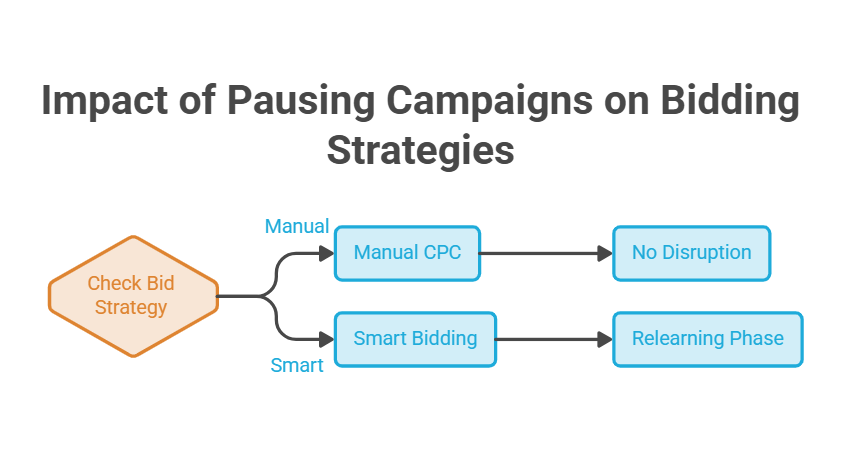
The relearning problem is specific to Smart Bidding strategies, Target CPA, Target ROAS, Maximize Conversions. These rely on a constant stream of recent conversion data to set bids automatically. Cut that stream off for a few weeks, and the system is effectively guessing again when it restarts.
If you’re not sure which one your account uses, it’s listed under the campaign’s Bid Strategy setting. Most small business accounts running on autopilot through an agency are on some form of Smart Bidding, which is exactly why this matters more than most owners realize.
When Pausing Is Fine?
This isn’t a reason to never pause. A business that’s closing for two weeks, has no capacity to take new jobs, or is sitting on zero inventory has a real reason to stop spending, pausing is correct there.
Short pauses (a few days) on a campaign with a long, strong conversion history also tend to bounce back faster than campaigns that were still new or inconsistent before the pause.
The problem is pausing by default, as the first lever pulled any time budget feels tight, without checking whether a lighter option would do the same job.
The Better Alternative than pausing google ads
Instead of an on/off switch, there are three ways to reduce spend without triggering a full relearning cycle:
1. Lower the daily budget, don’t pause the campaign.
Cutting a $100/day budget to $40/day still spends less, but keeps the campaign live and feeding Smart Bidding fresh data the whole time. No relearning phase gets triggered just by a budget change.
2. Use ad scheduling to narrow hours, not stop entirely.
If leads only convert during business hours anyway, scheduling ads to run fewer hours a day reduces spend while keeping the campaign technically active.
3. Shift budget to your best performing campaign instead of cutting all of them evenly.
If three campaigns are running and one converts at half the cost of the others, moving budget away from the weak one (instead of pausing everything) protects your best source of leads while still cutting total spend.
Any of these three can achieve the same budget goal as a pause, without resetting the learning phase that makes automated bidding work.
If You Must Pause
Sometimes a full stop really is necessary, the business is closing, or the budget is gone, not just reduced. If that’s the case, two things make the restart smoother:
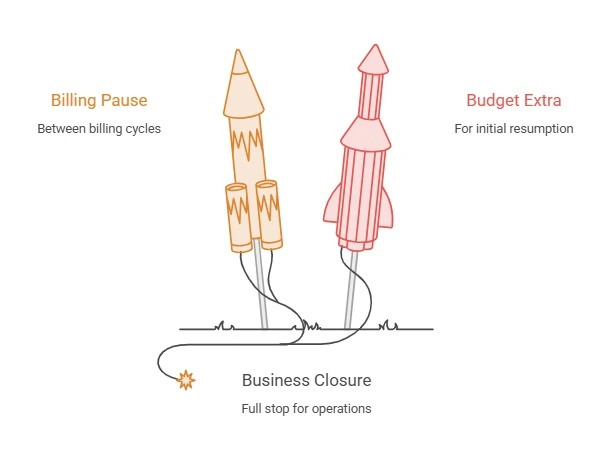
- Pause between billing cycles, not mid-month, so reporting doesn’t get split across a confusing partial period.
- Budget extra for the first 1 to 2 weeks after resuming. Expect cost-per-lead to run higher than your historical average during that window, and don’t panic or re-pause when it does, that just restarts the cycle again.
A Quick Way to Decide
Before pausing, ask one question: is the goal to spend less, or to spend nothing?
If the goal is to spend less, throttle the budget or the schedule instead of pausing. If the goal is genuinely zero spend because the business can’t take any new work right now, pause but plan for a bumpy week or two when it comes back.
A simple way to frame it for yourself: a budget cut is a dimmer switch. A google ads pause is a light switch. Most “we need to cut spend” moments only call for the dimmer.
The Bottom Line
Pausing a Google Ads campaign doesn’t erase its history, and it isn’t the disaster some agencies make it sound like. But it isn’t free either. The real cost shows up after the pause, in the relearning window most business owners never see coming.
A small budget cut, kept running, usually beats a full stop followed by a rebuild. If spend needs to come down, there’s almost always a way to do that without asking the algorithm to start over.
If you’re managing this alone and aren’t sure which bidding strategy your account is even on, that’s worth checking before your next “pause everything” month, it’s a two minute look that can save weeks of relearning later.